
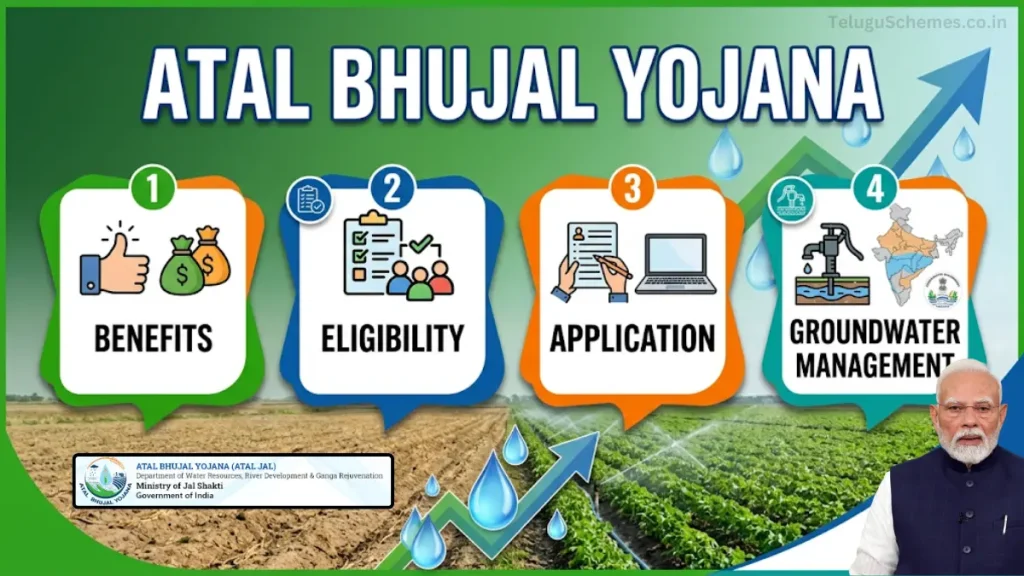
Atal Bhujal Yojana: Complete Guide to Benefits, Eligibility, Application & Groundwater Management
Scheme Details
| Launched By | Government of India (Ministry of Jal Shakti) |
|---|---|
| Launch Year | 2009 |
| Benefit | Community-led sustainable groundwater recharge, water conservation & demand-side management in water-stressed areas |
| Beneficiaries | Gram Panchayats, farmers, local communities & water users in water-stressed regions |
| Last Verified | 10 Jun 2026 |


Atal Bhujal Yojana: India faces a severe groundwater crisis, with the country being the world’s largest user of this vital resource. Over-extraction for irrigation, urbanization, climate change impacts, and inefficient management practices have led to rapidly depleting aquifers, threatening drinking water supplies, agricultural productivity, and overall water security for millions. In response, the Atal Bhujal Yojana (also known as Atal Jal) stands out as a pioneering central sector scheme designed to promote community-led, sustainable groundwater management in the most water-stressed regions. Launched to address these challenges through demand-side interventions, behavioral change, and institutional strengthening, the scheme emphasizes participatory approaches involving local communities, particularly at the Gram Panchayat level.
By integrating water security planning into local development frameworks and encouraging recharge activities alongside efficient water use, Atal Bhujal Yojana aims to reverse the trend of groundwater decline while building long-term resilience. The initiative not only focuses on immediate improvements in water availability but also fosters awareness and ownership among stakeholders to ensure sustainability beyond the project’s duration. Its community-driven model has demonstrated promising results in selected areas, offering valuable lessons for nationwide replication.
Atal Bhujal Yojana (Scheme) Overview
Atal Bhujal Yojana, often referred to as Atal Jal, is a flagship program under the Ministry of Jal Shakti that targets sustainable groundwater management. It was approved by the World Bank in 2018 and launched by the Government of India on December 25, 2019, coinciding with the 95th birth anniversary of former Prime Minister Atal Bihari Vajpayee. Implementation began in 2020 with a focus on seven priority states facing acute water stress.
The scheme operates as a Central Sector Scheme with a total outlay of Rs. 6,000 crore, funded equally (50:50) by the Government of India and the World Bank. The World Bank’s contribution is provided as a loan, while central assistance is passed on to states as grants. It promotes panchayat-led groundwater management with a strong emphasis on demand-side measures, such as efficient irrigation, crop diversification, and behavioral change among users.
| Details | Information Description |
|---|---|
| Scheme Launch Year / Date | December 25, 2019 (Implementation from 2020) |
| Currently Active or Not | Completed pilot phase (2020-2025); model for replication by states |
| Category | Central Sector Scheme (Groundwater Management) |
| Beneficiary | Communities, farmers, Gram Panchayats in water-stressed areas |
| Mode of Apply | Through Gram Panchayats, local bodies, and state implementing agencies |
| Official Website | https://ataljal.mowr.gov.in |
| Funding Pattern | Rs. 6,000 crore (50% GoI, 50% World Bank) |
| Implementing Ministry | Ministry of Jal Shakti |
| Target Areas | 8,203 Gram Panchayats in 229 blocks across 80 districts |
Atal Bhujal Yojana distinguishes itself through its focus on data disclosure, community mobilization, and performance-based incentives, making it a replicable model for participatory water governance across India.
Atal Bhujal Yojana Scheme Benefits
Groundwater Improvement & Water Security
The scheme improves groundwater levels through recharge structures such as check dams, percolation ponds, and rainwater harvesting systems. These interventions help recharge significant volumes of water, improving availability for drinking, irrigation, and other essential needs.
Community Participation & Awareness
Atal Bhujal Yojana empowers local communities through awareness campaigns, training programs, and Gram Panchayat participation. Women and marginalized groups are encouraged to take part in water management decisions, creating long-term behavioral change toward water conservation.
Agricultural & Environmental Benefits
Demand-side activities such as micro-irrigation and crop diversification help reduce water usage while improving agricultural efficiency and farmer incomes. The scheme also supports ecosystem health, reduces land subsidence risks, and helps prevent saltwater intrusion in coastal regions.
Atal Bhujal Yojana Required Documents
Participation typically involves community or institutional proposals facilitated by state agencies. Key documents often include:
- Proof of identification and land or community resource details.
- Detailed Water Security Plan or groundwater management strategy outlining proposed activities.
- Local authority approvals or resolutions from Gram Panchayats.
- Baseline data on water resources, extraction patterns, and recharge potential.
- Monitoring and evaluation frameworks for proposed interventions.
Applicants must demonstrate how funds will be used for recharge, conservation, or capacity-building activities while aligning with scheme guidelines.
How to Apply for Atal Bhujal Yojana – Detailed Explanation
Applying under Atal Bhujal Yojana is primarily a community and institutional process coordinated through state-level Project Management Units. Interested Gram Panchayats, water committees, or local bodies should first visit the official website (https://ataljal.mowr.gov.in) to download guidelines, formats, and access the Management Information System (MIS).
- Preparation: Conduct water budgeting and prepare a comprehensive Water Security Plan in consultation with community members and technical experts from the Central Ground Water Board or state departments.
- Submission: Submit proposals through the designated state implementing agency or District Project Management Unit. Proposals are reviewed based on scientific merit, community involvement, and potential impact.
- Approval and Funding: Selected plans receive performance-based grants. Funds support activities like structure construction, training, and incentive disbursements for achieving targets such as improved water levels or reduced extraction.
- Implementation and Monitoring: Execute activities with regular data disclosure on groundwater levels and usage. Convergence with other schemes like PMKSY or Jal Shakti Abhiyan is encouraged for better outcomes.
The process emphasizes transparency, with public disclosure of data through dashboards and portals. Technical support is available from national and state-level cells.
Atal Bhujal Scheme Contact Info
For queries, contact the National Project Management Unit (NPMU) or state units.
- Email: atal-jal@gov.in
- Toll-Free Helpline: 1800-11-0121 (Grievance Redressal)
- Official Website: https://ataljal.mowr.gov.in
- Address: Department of Water Resources, River Development & Ganga Rejuvenation, Ministry of Jal Shakti, New Delhi.
State-specific Project Management Units provide localized support in the seven implementing states.
Atal Bhujal Yojana Relevant Links
- Official Portal: https://ataljal.mowr.gov.in
- MIS and Data Dashboard: https://ataljal-mis.mowr.gov.in/WspNew/WSP_GWM_HOME
- Program Guidelines and Documents: https://ataljal.mowr.gov.in/Home/ContentManagement/ProgramGuidelines/EN
- State Portals (e.g., Karnataka): Check respective government sites for localized information.
Pros and Cons of Atal Bhujal Yojana
Pros
- Strong community participation and empowerment model.
- Data-driven approach with public disclosure improving transparency.
- Significant recharge and water savings achieved in pilot areas.
- Performance-based incentives encouraging results.
- Replicable framework for other states.
Cons
- Limited geographical coverage with only seven states in the pilot phase.
- Outcomes like reversal of groundwater decline may take time.
- Dependence on active community and state-level implementation.
- Challenges in scaling without dedicated funding after the pilot phase.
Finance Disclaimer: This article is for informational purposes only and does not constitute financial or legal advice. Readers should verify the latest details from official government sources, as scheme status and guidelines may evolve.