
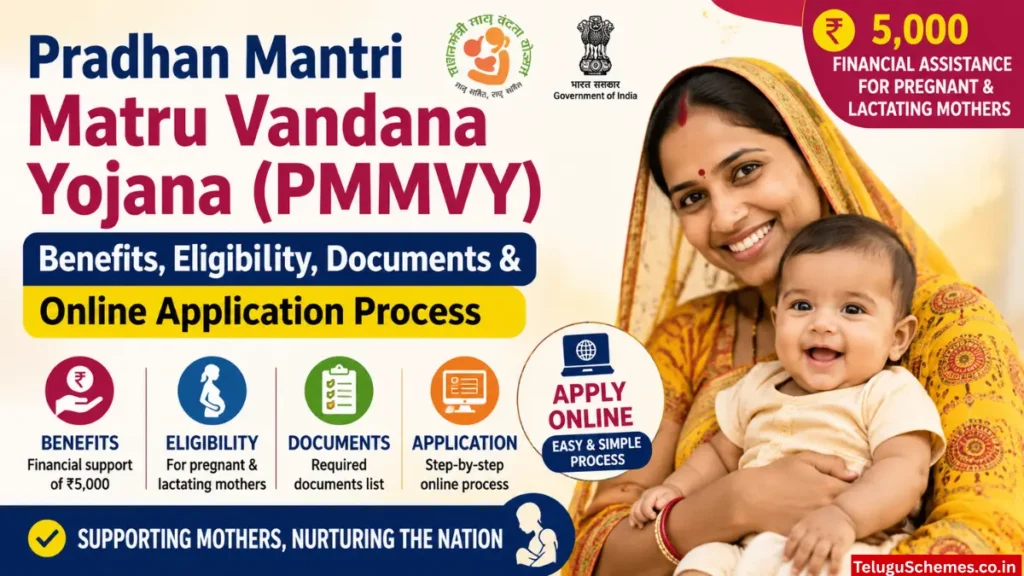
Pradhan Mantri Matru Vandana Yojana (PMMVY): Benefits, Eligibility, Documents & Online Application Process
Scheme Details
| Launched By | Ministry of Women and Child Development, Government of India |
|---|---|
| Launch Year | 2017 |
| Benefit | Cash incentives of ₹5,000 (1st child) / ₹6,000 (2nd girl child) |
| Beneficiaries | Pregnant & lactating women from disadvantaged sections |
| Last Verified | 12 Jul 2026 |
| Official Portal | Visit Official Website ↗ |


Pradhan Mantri Matru Vandana Yojana (PMMVY): is a flagship initiative by the Ministry of Women and Child Development, Government of India. It offers direct financial support to pregnant women and lactating mothers, particularly from socially and economically disadvantaged backgrounds. Launched to promote maternal and child health, the scheme provides cash incentives to help compensate for wage loss during pregnancy and the early months after childbirth. It encourages proper antenatal care, institutional deliveries, and timely vaccinations while aiming to improve overall family well-being.
Under the updated PMMVY 2.0 guidelines integrated with Mission Shakti, the scheme places special emphasis on promoting the value of the girl child. It offers enhanced benefits for a second child if she is a girl, contributing to efforts to improve the sex ratio at birth and discourage female foeticide. The program operates as a centrally sponsored scheme across India, with implementation involving Anganwadi Centres, ASHA workers, and health facilities. It has benefited millions of women by linking maternity support with nutrition and health-seeking behaviors.
Pradhan Mantri Matru Vandana Yojana (PMMVY) Overview
Pradhan Mantri Matru Vandana Yojana (PMMVY) is a conditional cash transfer program designed to provide maternity benefits and support better health outcomes for mothers and children. It focuses on the first two living children, with specific incentives tied to fulfilling health-related conditions.
| Details Information | Information |
|---|---|
| Scheme Launch Year / Date | January 1, 2017 |
| Currently Active or Not | Yes (PMMVY 2.0 ongoing under Mission Shakti) |
| Category | Maternity Benefit / Women Empowerment / Health & Nutrition |
| Beneficiary | Pregnant Women & Lactating Mothers from disadvantaged sections |
| Mode of Apply | Online via portal/app, Offline at Anganwadi Centres |
| Official Website | https://pmmvy.wcd.gov.in/ |
| Launched By | Ministry of Women and Child Development, Government of India |
| Additional Incentive | Linked with Janani Suraksha Yojana (JSY) for institutional delivery |
This table summarizes key facts for quick reference.
Pradhan Mantri Matru Vandana Yojana (PMMVY) Scheme Benefits
Pradhan Mantri Matru Vandana Yojana (PMMVY) delivers targeted cash support to eligible women. For the first living child, beneficiaries receive a total of ₹5,000 in two installments, plus potential additional benefits under JSY, bringing the average support close to ₹6,000.
- First Installment (₹3,000): Released upon early registration of pregnancy and at least one antenatal check-up within six months from the last menstrual period (LMP) at an Anganwadi Centre or approved health facility.
- Second Installment (₹2,000): Disbursed after childbirth registration and completion of essential vaccinations for the child up to 14 weeks (as per Universal Immunization Programme).
For the second child, if the child is a girl, a lump-sum benefit of ₹6,000 is provided in a single installment after birth registration and vaccination conditions are met. This incentive under PMMVY 2.0 aims to foster positive attitudes toward girl children.
In cases of miscarriage or stillbirth, the beneficiary is treated as a fresh case for future pregnancies. Benefits are directly transferred to the Aadhaar-linked bank or post office account.
PMMVY Eligibility Requirements
PMMVY targets women who are at least 19 years old and belong to socially and economically disadvantaged groups.
- Pregnant or lactating mothers for their first or second living child (second child benefit only if girl).
- Women from Scheduled Castes (SC), Scheduled Tribes (ST), or holding BPL ration cards.
- Holders of e-Shram card, MGNREGA Job Card, or PM-KISAN beneficiaries.
- Women covered under PMJAY (Ayushman Bharat), disabled (40% or more), or with family income below ₹8 lakh per annum.
- Pregnant and lactating Anganwadi Workers (AWWs), Helpers (AWHs), and ASHAs.
- Holders of NFSA 2013 ration cards or other categories notified by the Central Government.
- Women in regular employment with Central/State Government, PSUs, or those receiving similar maternity benefits under other laws are not eligible.
- The husband’s Aadhaar is not mandatory.
- Applications should ideally be made within 270–730 days from relevant dates, depending on guidelines.
PMMVY Required Documents
PMMVY requires standard identification and proof documents for smooth processing. Check the documents below before applying.
How to Apply for Pradhan Mantri Matru Vandana Yojana
Pradhan Mantri Matru Vandana Yojana (PMMVY) offers both online and offline application modes for convenience.
Offline Process:
- Visit the nearest Anganwadi Centre (AWC) or approved health facility.
- Submit Form 1-A (available at AWC or downloadable from the official website) with all supporting documents and consent.
- Anganwadi Worker/ASHA will assist with registration and verification.
Online Process:
- Visit the official portal at https://pmmvy.wcd.gov.in/.
- Create an account or log in using mobile number/credentials.
- Select “Beneficiary Registration” under Data Entry.
- Fill in personal details, choose first or second child option, upload documents, and submit.
- Track status via the portal or mobile app (PMMVY Soft for field functionaries).
A mobile app facilitates registration and tracking. Ensure all conditionalities are met for installment releases.
PMMVY Contact Info
PMMVY grievances and queries can be directed to:
- Helpline: 1515 (9:00 AM to 6:00 PM).
- Email: pmmvy-mwcd@gov.in.
- State/District nodal officers (details available on the official portal).
- For Delhi-specific contacts, refer to district-level officers listed on state websites.
PMMVY Relevant Links
- Official Portal: https://pmmvy.wcd.gov.in/
- Mission Shakti Guidelines: Click Here
- Mobile App: Click Here
- Forms: Form 1-A, 1-B, 1-C
- Form 1-A: Click Here
- Form 1-B: Click Here
- Form 1-C: Click Here
- Download PMMVY FAQs: Click Here
- Enrolments Under PMMVY
- Citizen Training Video
- [PMMVY FAQ]
Pros and Cons of Pradhan Mantri Matru Vandana Yojana (PMMVY)
Pros
- Direct financial support reduces economic burden on mothers.
- Promotes health check-ups, vaccinations, and institutional deliveries.
- Special focus on girl child helps address gender imbalance.
- Easy DBT mechanism with minimal leakages.
- Nationwide coverage with integration into Mission Shakti.
Cons
- Limited to first two children (with conditions), excluding higher-order births.
- Strict conditionalities and documentation may pose challenges in remote areas.
- Awareness levels vary, leading to lower uptake in some regions.
- Excludes certain employed women despite needs.
Pradhan Mantri Matru Vandana Yojana FAQs
It is a government maternity benefit scheme providing cash incentives to eligible pregnant and lactating mothers for the first two living children (second if girl).
Pregnant women aged 19+ from disadvantaged sections for their first or qualifying second child, subject to eligibility criteria.
₹5,000 for the first child (in installments) and ₹6,000 for the second girl child (single installment).
Yes, within stipulated timelines (up to 270–730 days depending on stage), but early registration is recommended.
The beneficiary is treated as a fresh case for any future pregnancy.
Yes, it is a centrally sponsored scheme available in all states and union territories.
Finance Disclaimer: This article is for informational purposes only. Scheme benefits, guidelines, and eligibility may be subject to updates by the Government of India. Always verify the latest details on the official website and consult authorized officials before applying. Financial decisions should consider individual circumstances.