
Pradhan Mantri Krishi Sinchayee Yojana (PMKSY): Benefits, Eligibility, How to Apply & Full Guide
Scheme Details
| Launched By | Department of Agriculture & Farmers Welfare, Ministry of Agriculture & Farmers Welfare, Govt. of India |
|---|---|
| Launch Year | 2015 |
| Benefit | Micro irrigation subsidy (45-55%), water savings, higher yields |
| Beneficiaries | All Indian farmers (priority to small & marginal) |
| Last Verified | 09 Jul 2026 |
| Official Portal | Visit Official Website ↗ |


Pradhan Mantri Krishi Sinchayee Yojana (PMKSY) – Per Drop More Crop (PDMC): is a flagship initiative by the Government of India designed to transform water management in agriculture. Launched to address the critical challenges of water scarcity and inefficient irrigation practices, the scheme promotes the adoption of advanced micro-irrigation technologies like drip and sprinkler systems. By focusing on “Per Drop More Crop,” it aims to maximize crop productivity while minimizing water usage, ultimately boosting farmers’ incomes and ensuring sustainable agricultural growth across the country.
This comprehensive program forms an integral part of the broader Pradhan Mantri Krishi Sinchayee Yojana umbrella, which envisions “Har Khet Ko Pani” (water to every farm) through end-to-end solutions in water source creation, distribution, and efficient application. The Per Drop More Crop component specifically targets farm-level water efficiency, supporting precision irrigation, water conservation structures, and related activities. It has helped cover millions of hectares under micro-irrigation, contributing significantly to national goals of climate resilience, higher yields, and reduced dependency on traditional flood irrigation methods.
Pradhan Mantri Krishi Sinchayee Yojana (PMKSY) Per Drop More Crop Overview
The Pradhan Mantri Krishi Sinchayee Yojana (PMKSY): Per Drop More Crop (PDMC) was launched on 1st July 2015 by the Department of Agriculture & Farmers Welfare, Ministry of Agriculture & Farmers Welfare, Government of India. It remains currently active, now implemented under the Rashtriya Krishi Vikas Yojana (RKVY) from 2022-23 onwards.
| Details Information | Information |
|---|---|
| Scheme Launch Year / Date | 1st July 2015 |
| Currently Active or Not | Yes (under RKVY since 2022-23) |
| Category | Centrally Sponsored Scheme (Micro Irrigation & Water Efficiency) |
| Beneficiary | Farmers (small & marginal prioritized), across States and Union Territories |
| Mode of Apply | Offline through Block/District Agriculture Offices; DBT for subsidies |
| Official Website | https://pdmc.da.gov.in/ and https://pmksy.gov.in/ |
| Nodal Ministry | Ministry of Agriculture & Farmers Welfare |
| Key Focus | Micro Irrigation (Drip, Sprinkler), Water Conservation, Fertigation |
Additional columns for user benefit: Funding Pattern (60:40 Centre:State for most states; 90:10 for NE/Himalayan; 100% Centre for UTs); Maximum Coverage (5 hectares per beneficiary); Re-application (after 7 years typically).
Pradhan Mantri Krishi Sinchayee Yojana (PMKSY) Per Drop More Crop Scheme Benefits
The Per Drop More Crop component delivers substantial advantages to farmers by promoting efficient resource use. Key benefits include:
- Financial Assistance for installing drip and sprinkler irrigation systems, with 55% subsidy for small and marginal farmers and 45% for others. Subsidies are shared between Centre and States.
- Installation of micro-irrigation systems by farmers or approved companies, linked mandatorily to water sources for efficiency.
- Support for Other Interventions such as water harvesting structures, farm ponds, water lifting devices, and secondary storage.
- Promotion of fertigation (fertilizer application through irrigation), leading to better nutrient use and higher yields.
- Direct Benefit Transfer (DBT) directly into farmers’ bank accounts.
- Increased crop productivity, income enhancement, water savings (up to 40-50% in many cases), and employment opportunities in installation and maintenance.
- Convergence with schemes like MGNREGA for broader infrastructure support.
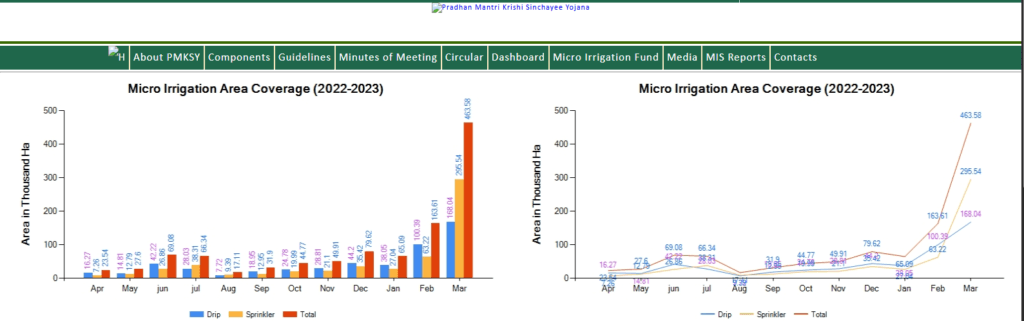
These measures have already brought significant areas under micro-irrigation, with notable progress in states adopting the technology widely.
PMKSY Per Drop More Crop Eligibility Requirements
Eligibility is broad to maximize reach:
- The applicant must be an Indian citizen.
- All categories of farmers (small, marginal, and others) owning agricultural land in States/UTs are eligible.
- Assistance is capped at a maximum of 5 hectares per beneficiary.
- Beneficiaries must use only BIS-marked systems/components.
- Aadhaar linkage is mandatory for DBT benefits.
- Priority is often given to water-stressed areas, water-intensive crops, and small/marginal farmers.
Farmers in groundwater-stressed blocks or districts receive focused attention.
PMKSY Per Drop More Crop Required Documents
Before applying for the scheme, make sure you have all the required documents ready.
How to Apply for Pradhan Mantri Krishi Sinchayee Yojana Per Drop More Crop
The application process is primarily offline and farmer-friendly:
- Assess your field requirements and contact the local Block or District Agriculture Office via Gram Panchayat or directly.
- Reach out to the Agriculture Officer or call the Kisan Call Centre (Toll-Free: 1800-180-1551) for guidance.
- Collect the application form from the concerned authority.
- Fill in all mandatory details accurately, affix a signed passport-size photo, and attach self-attested documents.
- Submit the completed form to the designated receiving officer.
- Obtain an acknowledgment receipt for future reference.
- Upon approval, install the system (self or through approved vendors), after which the subsidy is transferred via DBT.
States may have slight variations in implementation, but the core process remains standardized. Monitoring often involves mobile apps like BHUVAN PDMC for geo-tagging.
PMKSY Per Drop More Crop Contact Info
- National Level: Department of Agriculture & Farmers Welfare, Ministry of Agriculture & Farmers Welfare.
- Kisan Call Centre: 1800-180-1551 (Toll-Free).
- State Nodal Departments: Typically State Agriculture/Horticulture Departments (varies by state; check local offices).
- Official Portals: https://pdmc.da.gov.in/ for micro-irrigation details and https://pmksy.gov.in/ for overall scheme information.
- Local Block/District Agriculture Offices serve as primary contact points.
PMKSY Per Drop More Crop Relevant Links
- Official PDMC Portal: https://pdmc.da.gov.in/
- PMKSY Main Site: https://pmksy.gov.in/
- Guidelines and Circulars: Click Here
Pros and Cons of the Pradhan Mantri Krishi Sinchayee Yojana Per Drop More Crop Scheme
Pros
- Significant water savings and higher crop yields.
- Subsidies reduce upfront costs, making modern technology accessible.
- Promotes sustainable farming and climate resilience.
- Generates rural employment.
- DBT ensures transparency.
Cons
- Initial investment (even after subsidy) can be a barrier for very small farmers.
- Requires technical knowledge for maintenance.
- Limited to 5 hectares per beneficiary.
- Implementation varies across states, leading to uneven adoption.
- Dependence on approved vendors and BIS standards.
Pradhan Mantri Krishi Sinchayee Yojana Per Drop More Crop FAQs
It primarily focuses on enhancing farm-level water use efficiency through micro-irrigation technologies like drip and sprinkler systems, along with water conservation activities.
The Ministry of Agriculture & Farmers Welfare, through the Department of Agriculture & Farmers Welfare.
It was launched on 1st July 2015.
The four main components are Accelerated Irrigation Benefit Programme (AIBP), Har Khet Ko Pani, Per Drop More Crop, and Watershed Development.
Yes, with shared funding between Centre and States.
Farmers can apply offline through local Agriculture Offices with required documents; subsidies are disbursed via DBT.
Finance Disclaimer: This article provides general information based on publicly available sources. Subsidy amounts, eligibility, and guidelines may vary by state and are subject to official notifications. Farmers should verify the latest details with local authorities or official portals before applying. This is not financial advice.