
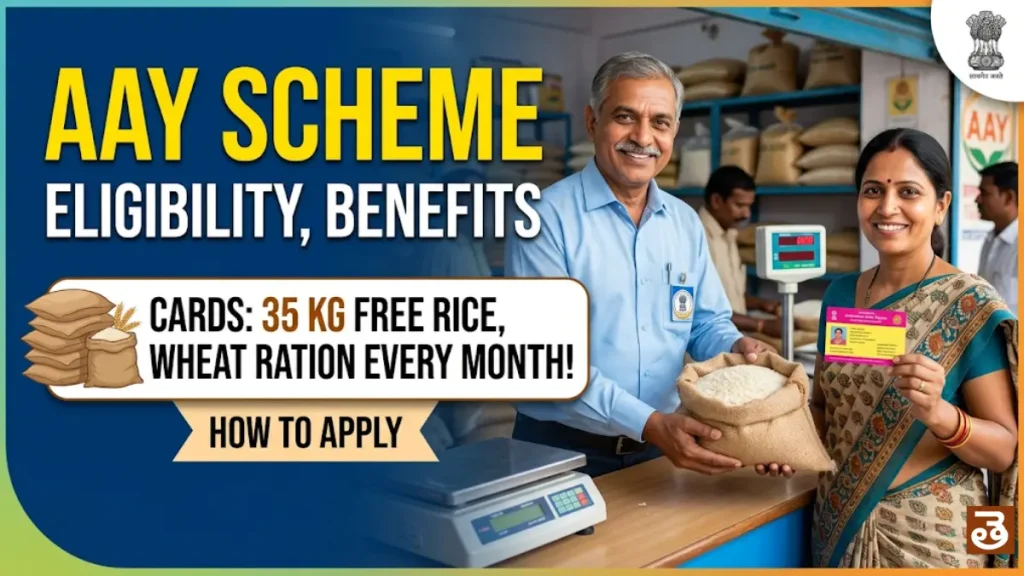
Antyodaya Anna Yojana (AAY) 2026: Benefits, Eligibility, Documents & How to Apply for Free Ration Card
Scheme Details
| Launched By | Government of India (Ministry of Consumer Affairs, Food and Public Distribution) |
|---|---|
| Launch Year | 2000 |
| Benefit | 35 kg food grains (rice/wheat) per household monthly, currently provided free under PMGKAY extensions |
| Beneficiaries | Poorest of the poor households (widows, elderly >60, disabled, landless labourers, rural artisans, urban slum dwellers, informal workers, etc.) holding AAY ration cards |
| Last Verified | 10 Jun 2026 |
| Official Portal | Visit Official Website ↗ |


Antyodaya Anna Yojana (AAY) is a flagship food security initiative by the Government of India designed to support the poorest of the poor households across the country. Launched to address severe hunger and malnutrition among the most vulnerable populations, the scheme operates under the Targeted Public Distribution System (TPDS) and National Food Security Act (NFSA). It provides a fixed monthly quota of food grains at highly subsidized rates – or currently free of cost under extensions like Pradhan Mantri Garib Kalyan Anna Yojana (PMGKAY) – ensuring that economically disadvantaged families have reliable access to essential staples like rice and wheat.
Over the years, Antyodaya Anna Yojana has expanded its coverage significantly, prioritizing groups such as widows, the elderly, disabled persons, and those in informal sectors. By integrating with state-level implementation and grievance redressal mechanisms, the scheme not only combats immediate food insecurity but also contributes to broader goals of poverty alleviation and nutritional improvement. This comprehensive support system remains a critical lifeline for millions, particularly in rural and urban slum areas where stable income sources are scarce.
Antyodaya Anna Yojana Overview
Antyodaya Anna Yojana, often abbreviated as AAY, stands as one of India’s most targeted welfare programs aimed at the bottom-most rung of society. Introduced to refine the public distribution system by focusing resources on the neediest, the scheme identifies specific households through rigorous state-led surveys and prioritizes them for enhanced benefits. It has evolved through multiple expansions to cover additional vulnerable categories while maintaining a consistent entitlement of food grains.
The program emphasizes transparency, with ration cards serving as the primary identification tool. Beneficiaries can access allocations through a vast network of fair price shops. Integration with digital platforms has made tracking and application processes more accessible in many states.
| Details | Information |
|---|---|
| Scheme Launch Year / Date | 25 December 2000 (first implemented in Rajasthan on 1 May 2001 for distribution) |
| Currently Active or Not | Yes, fully active and integrated with PMGKAY (extended till at least December 2028) |
| Category | Food Security / Public Distribution System (under NFSA) |
| Beneficiary | Poorest of the poor households, including AAY ration card holders |
| Mode of Apply | Online via state food portals / National Food Security Portal; Offline via local rationing offices, Panchayats, or Urban Local Bodies |
| Monthly Entitlement | 35 kg food grains per household |
| Current Pricing | Free of cost under PMGKAY extensions |
Antyodaya Anna Yojana Scheme Benefits
Antyodaya Anna Yojana delivers substantial food security benefits to eligible families. Each household receives 35 kg of food grains every month, typically a combination of rice and wheat based on regional preferences. Under current PMGKAY provisions, these grains are provided completely free of cost, removing previous nominal rates of ₹3 per kg for rice and ₹2 per kg for wheat.
This consistent supply significantly reduces household food expenditure, allowing families to allocate limited resources toward education, healthcare, or other essentials. The scheme also indirectly supports nutrition by ensuring access to staple calories for daily wage earners, the elderly, and disabled individuals who might otherwise skip meals. Additional provisions in some states include sugar subsidies. Large-scale distribution – handling millions of tonnes annually – demonstrates the government’s commitment to reaching remote areas through the Food Corporation of India (FCI) and state agencies.
AAY Eligibility Requirements
- Families headed by widows, terminally ill persons, disabled individuals, and elderly persons above 60 years with no support.
- Landless agricultural laborers and marginal farmers are given priority under the scheme.
- Rural artisans and craftsmen such as potters, weavers, blacksmiths, carpenters, and tanners can qualify.
- Urban informal workers including porters, coolies, rickshaw pullers, fruit and flower sellers, rag pickers, cobblers, and slum dwellers are covered.
- Families with annual income up to ₹15,000 in rural or urban areas may be eligible.
- HIV/AIDS and leprosy-affected persons in BPL categories also receive priority in certain cases.
AAY Required Documents
Applicants for an AAY ration card typically need to submit several key documents to verify identity, income, and eligibility:
- BPL certificate or proof of being below the poverty line
- Income certificate issued by competent authority (showing low or no stable income)
- Residence proof (Aadhaar card, voter ID, ration card if existing, or utility bills)
- Identity proof (Aadhaar, PAN, or similar)
- Affidavit or certificate confirming no prior ration card (or deletion certificate if applicable)
- Supporting documents for special categories (e.g., disability certificate, widow certificate, age proof, medical records for terminal illness)
Having complete documentation speeds up verification and approval at local offices. The AAY ration card itself serves as a vital KYC document for other government services.
How to Apply for Antyodaya Anna Yojana – Detailed Explanation
Applying for Antyodaya Anna Yojana can be done through both online and offline channels, making it accessible across diverse regions.
Online Application Steps:
- Visit the National Food Security Portal (nfsa.gov.in) or your state’s food and civil supplies portal.
- Select the option to apply for a new ration card or AAY benefits.
- Choose your state/UT from the list of food portals.
- Fill in personal and family details, upload required documents, and provide income and category information.
- Submit the application and note the reference number for tracking.
- Follow up with local authorities if verification is needed.
Offline Application Steps:
- In rural areas, approach the local Panchayat, Gram Sabha, or Block Development Office.
- In urban areas, visit the Department of Urban Development, Municipal Corporation, or nearest rationing office.
- Submit the application form along with supporting documents.
- The authorities will verify details, prepare a tentative list, and seek approvals (e.g., through Gram Sabha).
- Upon selection within state targets, the AAY ration card is issued, allowing collection from fair price shops.
States handle identification within allocated targets, so inclusion depends on local surveys and priority lists.
AAY Contact Info
For queries, beneficiaries can reach out to:
- National Helpline: Toll-free numbers like 1967 (Anna Sahayata) or 14457 (IVRS).
- Department of Food and Public Distribution: Central contact via dfpd.gov.in.
- State Civil Supplies Departments: Visit respective state portals (e.g., mahafood.gov.in for Maharashtra) or local rationing offices.
- District Grievance Redressal Officers (DGROs): Handle complaints at the district level.
- Fair Price Shop Dealers: First point for monthly collection issues.
WhatsApp-based support and mobile apps in several states further enhance accessibility.
AAY Relevant Links
- Official DFPD Website: https://dfpd.gov.in/
- National Food Security Portal: https://nfsa.gov.in/
- PMGKAY Details: https://dfpd.gov.in/pradhan-mantri-garib-kalyan-anna-yojana/en
- State-specific portals (search “[Your State] Food Civil Supplies”)
Pros and Cons of Antyodaya Anna Yojana
Pros
- Provides free or heavily subsidized essential food, directly reducing hunger.
- Targets the most vulnerable with fixed higher entitlements (35 kg vs. 5 kg per person for others).
- Promotes inclusivity across rural-urban divides and special categories.
- Integrates with broader welfare like PMGKAY for extended free benefits.
- Supports nutritional stability and indirect poverty reduction.
Cons
- Limited by state-wise targets, so not all eligible may be covered immediately.
- Occasional issues with leakages, quality of grains, or shop timing in some areas.
- Identification process can be bureaucratic or prone to inclusion/exclusion errors.
- Dependence on fair price shops may limit flexibility compared to cash transfers.
- Administrative burden on states for transportation and distribution costs.
Antyodaya Anna Yojana continues to play a pivotal role in India’s fight against food insecurity, offering a structured safety net for the nation’s poorest families.
Finance Disclaimer: This article is for informational and educational purposes only. Scheme details, benefits, and processes may vary by state and are subject to government updates. Readers should verify the latest information from official sources and consult relevant authorities before applying. No financial or investment advice is provided.