
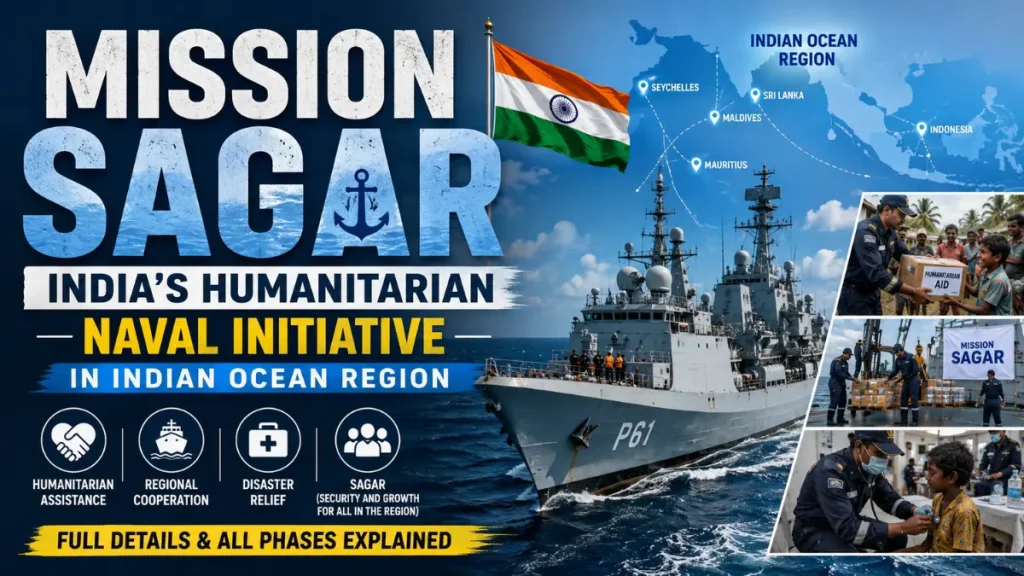
Mission Sagar Scheme: India’s Humanitarian Naval Initiative in Indian Ocean Region – Full Details & All Phases Explained
Scheme Details
| Launched By | Indian Navy & Ministry of External Affairs (MEA), Government of India |
|---|---|
| Launch Year | 2020 |
| Benefit | Delivery of humanitarian aid (food, medicines, oxygen, HADR support) to strengthen regional diplomacy and maritime cooperation under SAGAR vision |
| Beneficiaries | Indian Ocean littoral states & friendly maritime neighbors (Maldives, Mauritius, Seychelles, Madagascar, Comoros, Sri Lanka, Mozambique, Vietnam, Cambodia, Indonesia, Bangladesh, Sudan, South Sudan, Djibouti, Eritrea, etc.) |
| Last Verified | 20 Jun 2026 |
| Official Portal | Visit Official Website ↗ |


Mission Sagar: stands as one of India’s most prominent humanitarian and diplomatic initiatives in the Indian Ocean Region. Launched during the challenging times of the COVID-19 pandemic, this naval outreach program demonstrated India’s readiness to support its maritime neighbors with timely assistance. Through coordinated efforts by the Indian Navy and the Ministry of External Affairs, Mission Sagar strengthened bilateral ties while reinforcing India’s image as a reliable first responder in regional crises.
The mission not only delivered critical supplies like food, medicines, and medical oxygen but also aligned with India’s broader SAGAR (Security and Growth for All in the Region) vision. It showcased India’s maritime capabilities across multiple phases, reaching countries from Africa to Southeast Asia. By combining humanitarian aid with strategic diplomacy, Mission Sagar has become a powerful symbol of regional solidarity and cooperation.
Mission Sagar Overview
Mission Sagar is India’s dedicated humanitarian outreach program that utilizes naval assets to deliver essential aid to countries in the Indian Ocean Region and beyond. Initiated in response to the COVID-19 pandemic, it reflects India’s commitment to maritime neighborhood diplomacy and disaster relief. The initiative has evolved through multiple phases, each addressing specific needs such as food security, medical support, and recovery from natural disasters.
| Details | Information |
|---|---|
| Scheme Launch Year/Date | May 2020 |
| Currently Active or Not | Completed major phases (up to IX); framework continues under SAGAR vision |
| Category | Humanitarian Aid, Maritime Diplomacy, HADR |
| Beneficiary | Indian Ocean Littoral States and friendly maritime neighbors |
| Mode of Apply | Government-to-Government initiative (No public application) |
| Official Website | mea.gov.in (Ministry of External Affairs) |
| Coordinating Agency | Indian Navy in coordination with MEA |
| Total Phases | 9 phases (as of 2022) |
Mission Sagar Scheme Benefits
Humanitarian Support to Partner Nations
Mission Sagar provided over 3,000 metric tonnes of food aid, more than 300 metric tonnes of liquid medical oxygen, nearly 1,000 oxygen concentrators, and multiple ISO containers across various phases. These supplies proved vital during the peak of the pandemic and subsequent crises like droughts and floods.
Strengthened Regional Diplomacy
Beyond material assistance, the mission strengthened diplomatic relations, enhanced trust with maritime neighbors, and positioned India as a net security provider in the region.
Support During Emergencies
It supported countries facing terrorism threats, natural disasters, and healthcare emergencies through rapid humanitarian assistance and coordinated naval outreach operations.
Operational Experience for Indian Navy
Operationally, the Indian Navy gained valuable experience in long-duration deployments, covering nearly 40,000 nautical miles over more than 200 days at sea.
Mission Sagar Objectives
The primary objectives of Mission Sagar include delivering timely humanitarian and medical assistance during crises, fostering stronger maritime partnerships, and promoting regional stability. It serves as a practical implementation of the SAGAR vision by emphasizing security, economic cooperation, and sustainable growth for all countries in the Indian Ocean Region.
Vision SAGAR
SAGAR (Security and Growth for All in the Region), announced in 2015, forms the foundational policy guiding Mission Sagar. This strategic vision aims to create an inclusive, peaceful, and prosperous Indian Ocean Region through enhanced maritime cooperation, capacity building, and adherence to international maritime laws. It integrates with other initiatives such as the Act East Policy, Project Sagarmala, and the focus on the Blue Economy.
Mission Sagar Phases
Mission Sagar was executed in multiple phases, each tailored to address specific regional needs:
- Mission Sagar I (May-June 2020): INS Kesari delivered aid to Maldives, Mauritius, Madagascar, Comoros, and Seychelles.
- Mission Sagar II (November 2020): INS Airavat provided food aid to Sudan, South Sudan, Djibouti, and Eritrea.
- Mission Sagar III (December 2020): INS Kiltan supported Vietnam and Cambodia with HADR assistance.
- Mission Sagar IV (March 2021): Food aid to Comoros and Madagascar.
- Mission Sagar V & VI (August 2021): Oxygen support to Indonesia, Thailand, Vietnam, and Sri Lanka.
- Mission Sagar VII (September 2021): Mobile oxygen plants to Bangladesh.
- Mission Sagar VIII (December 2021): Food aid and defense equipment to Mozambique.
- Mission Sagar IX (April 2022): Critical medicines to Sri Lanka.
Mission Sagar Eligibility Requirements
As a government-led diplomatic initiative, Mission Sagar does not have public eligibility criteria like citizen welfare schemes. Participation is determined through bilateral diplomatic engagement between India and friendly maritime nations facing humanitarian or disaster-related challenges.
Pros and Cons of Mission Sagar
Pros
- Enhances India’s soft power and regional influence.
- Builds strong bilateral relationships and goodwill.
- Provides practical experience to the Indian Navy in HADR operations.
- Supports global health and food security efforts.
- Counters other powers’ influence through constructive engagement.
Cons
- High operational and financial costs for sustained deployments.
- Logistical complexities in covering vast maritime distances.
- Potential strain on naval resources during multiple simultaneous crises.
- Challenges in measuring long-term strategic impact.
Mission Sagar Contact Info
For official information, contact the Ministry of External Affairs (MEA) or the Indian Navy’s Public Relations wing. Queries can be directed through the MEA website or Indian diplomatic missions in respective countries.
Mission Sagar Relevant Links
- Official MEA Portal: mea.gov.in
- Indian Navy Website: https://indiannavy.gov.in/
- Press Information Bureau releases on Mission Sagar
SEO-Optimized FAQs
Mission Sagar is India’s humanitarian naval initiative launched in 2020 to provide COVID-19 relief and disaster assistance to Indian Ocean countries.
It has been conducted in nine phases between 2020 and 2022, each targeting specific countries with tailored aid.
Mission Sagar is a specific humanitarian operation, while SAGAR is India’s broader strategic vision for security and growth in the Indian Ocean Region.
Beneficiary countries include Maldives, Mauritius, Seychelles, Madagascar, Comoros, Sri Lanka, Mozambique, Vietnam, Cambodia, Indonesia, Bangladesh, and several East African nations.
While major phases concluded in 2022, the spirit of the initiative continues under India’s ongoing SAGAR policy and HADR operations.