
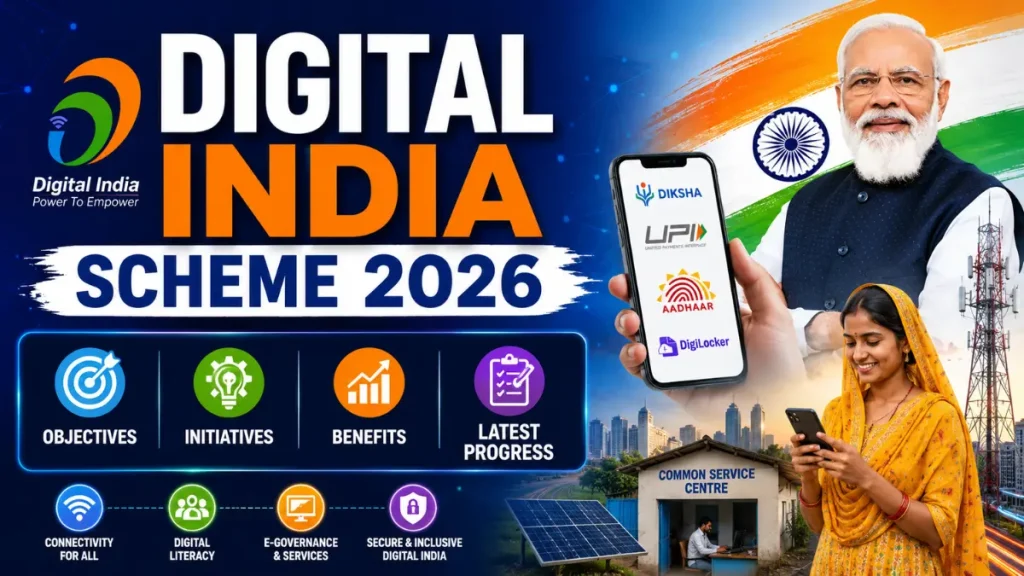
Digital India Scheme 2026: Objectives, Initiatives, Benefits & Latest Progress
Scheme Details
| Launched By | Government of India (Prime Minister Narendra Modi) / Ministry of Electronics and Information Technology (MeitY) |
|---|---|
| Launch Year | 2015 |
| Benefit | Builds digital infrastructure, delivers paperless e-governance services, promotes digital literacy, financial inclusion (UPI, JAM), and drives economic growth toward a $1 trillion digital economy. |
| Beneficiaries | All Indian citizens (with special focus on rural areas, students, farmers, and underserved populations). |
| Last Verified | 10 Jun 2026 |
| Official Portal | Visit Official Website ↗ |


Digital India: stands as a transformative flagship programme of the Government of India, launched to turn the nation into a digitally empowered society and a robust knowledge economy. Introduced on July 1, 2015, by Prime Minister Narendra Modi, the initiative addresses long-standing challenges of the digital divide by enhancing online infrastructure, expanding internet access, and promoting digital literacy across urban and rural regions alike.
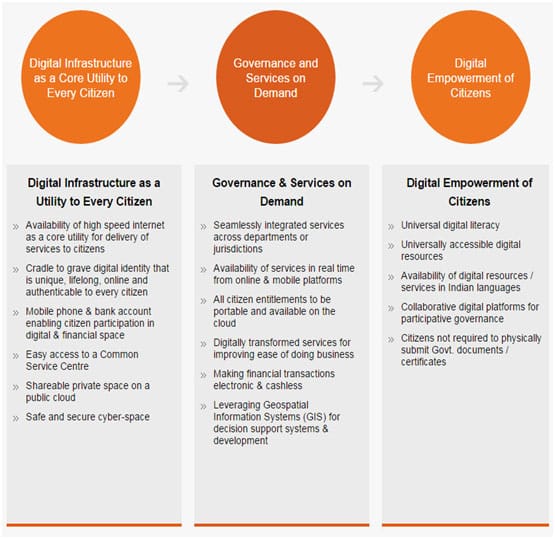
Through its three core pillars – creating secure digital infrastructure, delivering seamless digital services, and ensuring universal internet access – the programme has accelerated India’s digital transformation. It has fueled growth in key sectors like IT, electronics manufacturing, and digital communications, with projections indicating substantial contributions to the national economy. By bridging gaps in connectivity and empowering citizens with technology, Digital India continues to drive inclusive development and position India as a global digital leader.
Digital India Scheme Overview
Digital India is an umbrella initiative that integrates multiple schemes and programmes to digitize governance, economy, and society. It emphasizes collaboration between government, private sector, and citizens to build a digitally inclusive India.
| Details | Information |
|---|---|
| Scheme Launch Year / Date | July 1, 2015 |
| Currently Active or Not | Yes (Ongoing and expanding) |
| Category | Digital Infrastructure, e-Governance & Empowerment |
| Beneficiary | All Indian citizens, with focus on rural areas, students, farmers, and underserved populations |
| Mode of Apply | Online through various portals (e.g., MyGov, DigiLocker, CSC) |
| Official Website | www.digitalindia.gov.in |
| Implementing Ministry | Ministry of Electronics and Information Technology (MeitY) |
The initiative has evolved significantly, incorporating emerging technologies such as AI, quantum computing, and advanced data infrastructure.
Digital India Scheme Benefits
Digital India delivers wide-ranging benefits that touch every aspect of public life. It has dramatically improved digital connectivity, with internet subscribers reaching over 100 crore. Affordable data tariffs (among the lowest globally) have made internet access widespread.
Key benefits include:
Efficient Governance
Platforms like Aadhaar, DigiLocker, and MyGov enable paperless services, direct benefit transfers, and citizen engagement.
Economic Growth
The programme supports UPI transactions, which surged to 185.85 billion in FY25, and contributes to the digital economy’s expansion toward a $1 trillion target.
Education and Skilling
Initiatives like DIKSHA, PM eVIDYA, and NISHTHA provide millions of learning sessions and teacher training.
Healthcare Access
The Ayushman Bharat Digital Mission (ABDM) has created over 82 crore ABHA accounts, linking health records and professionals.
Rural Empowerment
BharatNet, CSCs, and PMGDISHA bring high-speed internet, digital services, and literacy to Gram Panchayats and villages.
Financial Inclusion
India Stack and JAM trinity facilitate seamless digital payments and welfare delivery.
These advancements have created jobs, enhanced service delivery, and fostered innovation.
Digital India Eligibility Requirements
Digital India components generally have broad eligibility to maximize reach. Most services are available to all Indian residents.
- Aadhaar: Any resident of India.
- DigiLocker and MyGov: Requires Aadhaar-linked mobile number or basic registration.
- PMGDISHA (Digital Literacy): Primarily targets rural households, aiming to make at least one member per eligible family digitally literate.
- BharatNet and Public Wi-Fi: Benefits entire communities in connected Gram Panchayats.
- CSCs: Serve local citizens for various government-to-citizen services.
There are no strict income or other barriers for core participation, making it highly inclusive.
Digital India Required Documents
Requirements vary by specific service but commonly include:
- Aadhaar Card (for identity verification and linkage).
- Mobile Number linked to Aadhaar.
- Proof of Address or identity documents for certain registrations.
- PAN Card for specific financial or tax-related digital services.
- Photographs and basic personal details for DigiLocker or MyGov profiles.
For rural digital literacy programmes, proof of residence in targeted areas may be needed. Most processes are now Aadhaar-based for simplicity and security.
How to Apply for Digital India – Detailed Explanation
Applying for or accessing Digital India services is straightforward and mostly online:
- Visit Official Portals: Go to www.digitalindia.gov.in, MyGov.in, or specific apps like DigiLocker or UMANG.
- Register with Aadhaar: Link your mobile number and complete e-KYC where required.
- Download Apps: Use DigiLocker, UMANG, or BHIM for services.
- Visit Common Service Centres (CSCs): For assisted access in rural areas, locate a nearby CSC for help with registrations, certificates, or training.
- Participate in Literacy Programmes: Enroll in PMGDISHA through local centres for digital skills training.
- Track Progress: Use dashboards on official sites for BharatNet connectivity or project status in Smart Cities.
Partnerships with tech giants like Google, AWS, and others provide additional training and innovation opportunities, such as the Build for Digital India programme.
Digital India Contact Info
- Helpline Number: 10505 (for Digital India queries)
- Email: di-webmaster@digitalindia.gov.in
- Official Website: https://www.digitalindia.gov.in/
- MeitY Support: Through respective state or district digital centres.
- CSC Helpline: Available via local centres for grassroots support.
Citizens can also engage via the MyGov platform for suggestions and feedback.
Digital India Relevant Links
- Official Digital India Portal: https://www.digitalindia.gov.in/
- DigiLocker: https://digilocker.gov.in/
- MyGov: https://mygov.in/
- Aadhaar (UIDAI): https://uidai.gov.in/
- BharatNet Updates: Through MeitY or BSNL portals
- ABDM (Health): https://abdm.gov.in/
Pros and Cons of the Scheme
Pros
- Massive scale in connectivity and digital public infrastructure.
- Promotes financial inclusion and efficient welfare delivery.
- Boosts innovation, jobs, and economic growth.
- Enhances transparency and reduces corruption through digitization.
- Inclusive focus on rural and underserved areas.
Cons
- Challenges in achieving full targets for public Wi-Fi hotspots and universal literacy.
- Persistent digital divide in some remote regions due to infrastructure gaps.
- Concerns around data privacy and cybersecurity.
- Dependence on reliable electricity and digital devices in rural areas.
- Need for continuous upskilling amid rapid technological changes.
Digital India remains a cornerstone of India’s development strategy, evolving toward an “Intelligent India” with AI and advanced technologies. Its sustained progress underscores the nation’s commitment to a digitally empowered future.